
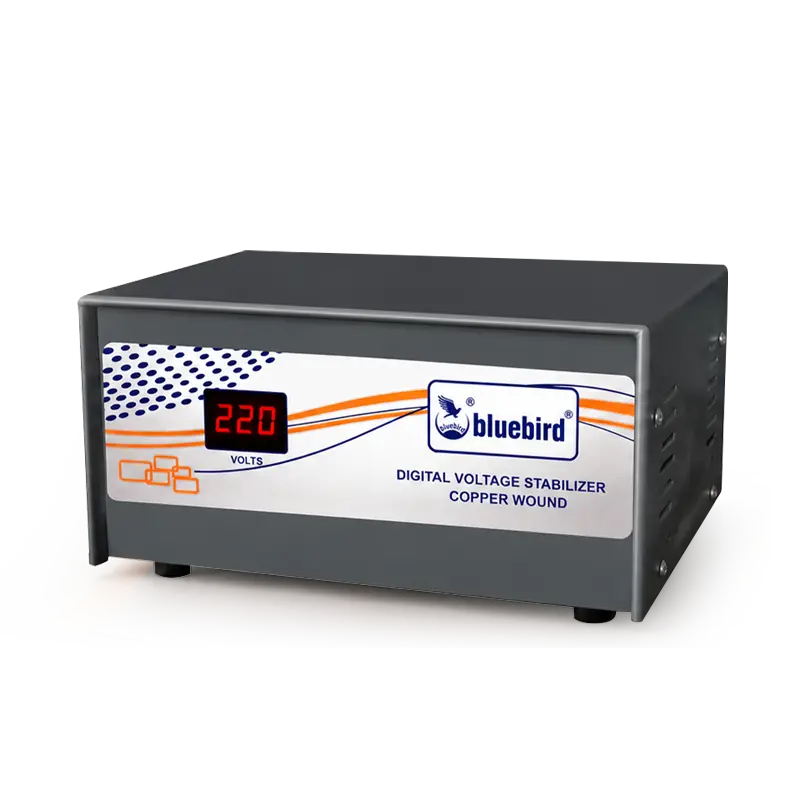
If you’ve ever watched the lights dim when the fridge compressor kicks in, or had a computer reboot for no obvious reason during a storm, you’ve already met the problem a voltage stabilizer exists to solve. Mains power is never as steady as the “230V” printed on your appliance nameplate suggests. It drifts, spikes, and sags all day long, and most electronics tolerate that badly.
A voltage stabilizer is an electrical device that sits between the incoming power supply and your equipment, and its only job is to hold the output at a constant, safe voltage no matter what the input is doing or how much load is drawn. It watches the incoming voltage continuously and corrects it in real time, so a supply swinging between 180V and 260V still reaches your equipment as a steady 220–230V.
That’s the short version. Here’s what’s actually happening inside one, and how to pick the right type for what you’re protecting.
Why Voltage Fluctuates in the First Place
Grid voltage isn’t a fixed number. It’s a moving target that utilities try to keep within a band. In India, the relevant standard (IS 12360) specifies single-phase supply at 230V with an allowed range of roughly 207V to 253V. In practice, especially outside dense urban feeders, actual voltage can swing well past that band.
A few things drive the swing:
- Distance from the substation matters: the farther a building sits from the transformer, the more voltage it loses along the line, especially during peak demand.
- Heavy motors, compressors, and industrial equipment starting up elsewhere on the same feeder pull the voltage down momentarily for everyone else on it.
- Storms, fallen branches, and temporary line faults cause sags and spikes as protection systems react.
- Voltage tends to sag during evening peak hours and can run high late at night, once demand drops but supply hasn’t scaled back.
- Aging or overloaded transformers, common on older distribution networks, struggle to hold a steady output under variable load.
None of this is a malfunction, exactly. It’s just how AC distribution behaves under real-world load. But it’s rough on anything with a motor, a compressor, or a circuit board.
What Happens If You Skip One
Under-voltage forces motors to draw more current to deliver the same output, which overheats windings and shortens the life of compressors in ACs, refrigerators, and pumps. Over-voltage does the opposite kind of damage: it stresses insulation and can degrade or outright kill circuit boards, displays, and control electronics in a single bad spike.
In a home, that usually shows up as appliances needing repair or replacement sooner than they should. On a factory floor it’s worse: CNC machines lose calibration, PLCs reset mid-cycle, and sensitive instruments throw false readings. The downtime and scrap that follows costs more than the stabilizer would have.
How a Stabilizer Actually Corrects Voltage
Every stabilizer, regardless of type, runs the same basic loop: sense the input voltage, compare it against a reference value, and adjust output until it matches. What differs is the mechanism used to make that adjustment, and that’s what separates the three main types on the market.
Relay-type (tap-switching) stabilizers work off a transformer with multiple fixed taps. A control circuit compares the incoming voltage to the target value, and when it drifts, the circuit switches in the tap that gets closest to the correct output. It responds in 10 to 50 milliseconds, and the mechanism is simple, though correction happens in steps rather than smoothly, so accuracy sits around ±8–10%. That’s enough for most household appliances and general-purpose loads, which is why relay-type units are the most common and the cheapest option on the market.
Servo-controlled stabilizers use a feedback circuit to drive a small DC motor connected to an autotransformer, or variac. As the motor turns, a carbon brush moves along the transformer windings, changing the turns ratio smoothly instead of in fixed steps. Accuracy holds around ±1%, though the extra moving parts mean occasional brush maintenance and a higher price than a relay-type unit. This is the type most industrial buyers reach for: motors, CNC equipment, and manufacturing lines where precision matters more than upfront cost.
There’s also the static, or electronic, stabilizer, often built around a constant voltage transformer or a ferro-resonant design. No moving parts means nothing to wear out mechanically and a near-instant response, which suits environments with frequent, rapid fluctuations. The tradeoff is cost, so these mostly show up in data centers, medical imaging equipment, and telecom installations rather than homes.
| Type | Accuracy | Moving parts | Typical use | Relative cost |
|---|---|---|---|---|
| Relay-type | ±8–10% | Relays, wear over time | Homes, general appliances | Lowest |
| Servo-controlled | ±1% | Motor + carbon brush | Industrial motors, CNC, manufacturing | Moderate–high |
| Static / CVT | High, near-instant | None | Data centers, medical, telecom | Highest |
Voltage Stabilizer vs. UPS: Two Different Jobs
These two get confused constantly, and it’s worth being clear on the distinction. A stabilizer corrects voltage that’s present but out of range; it doesn’t store energy and can’t keep anything running through an actual outage. A UPS, or uninterruptible power supply, does the opposite: it bridges a power cut using a battery, and while many UPS units include some voltage regulation, it’s usually cruder than what a dedicated stabilizer provides.
If your problem is unstable voltage, you need a stabilizer. If your problem is the power cutting out entirely, you need a UPS. For equipment that’s sensitive to both, you need both.
Sizing One Correctly
The most common mistake in buying a stabilizer is sizing it by the appliance’s power rating instead of its actual VA (volt-ampere) demand, particularly for anything with a motor (ACs, refrigerators, pumps) where the starting surge current runs well above the running current. As a rule of thumb, add up the VA rating of everything the stabilizer will protect, then leave 20–25% headroom above that total. Undersizing means the stabilizer trips or fails under load exactly when you need it; oversizing just wastes money on capacity you’ll never use.
The other decisions that matter: single-phase or three-phase (industrial equipment is almost always three-phase), the input voltage range you need it to tolerate (wider ranges matter more in areas with poor grid quality), and whether the load is a simple resistive one (heaters, lighting) or motor-driven with inrush current to account for.
Where These Get Used
Residential use is usually the simplest case: one stabilizer per AC unit, or a whole-house unit sized for the main load. Commercial settings (offices, retail, small workshops) typically need something in between, enough capacity for several loads without the ruggedness of a heavy industrial unit. Industrial and manufacturing environments are where the specification gets serious: three-phase servo or static units sized for continuous heavy load, matched to whatever precision the connected equipment needs, whether that’s a production line motor or a piece of test instrumentation that can’t tolerate even a small deviation.
Keeping One Running
Stabilizers are low-maintenance by design, but they’re not maintenance-free. Relay and servo units benefit from a periodic check of contacts and connections, since that’s where wear shows up first. Servo units specifically need their carbon brush inspected and replaced when worn, since a degraded brush is the most common cause of erratic output in an otherwise healthy unit. Keeping the unit ventilated and free of dust matters more than people expect: heat buildup inside the enclosure is a slow, steady cause of premature failure across every type. It’s also worth confirming the input range and capacity are still matched to your actual load if equipment has been added or replaced since installation. A stabilizer sized correctly five years ago may not be sized correctly today.
Bluebird has manufactured automatic voltage stabilizers, servo voltage stabilizers, constant voltage transformers, and isolation transformers out of Delhi for over four decades, for household and industrial use alike. Find the right type and capacity for your load before you buy. It’s the cheapest step in the whole process, and the one most often skipped.