
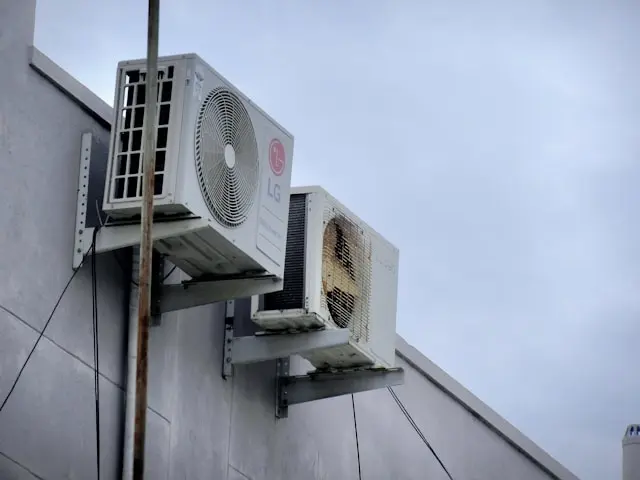
Switch on an air conditioner in most Indian homes and you’re rarely getting a clean, steady 220V. The grid hands you something closer to a moving target: 200V one hour, 250V the next, sometimes dipping and spiking within the same afternoon. That’s a voltage fluctuation: a departure from the standard supply voltage, caused by anything from a transformer fault at the local substation to your neighbor’s water pump switching on down the line.
An AC is one of the least forgiving appliances when it comes to unstable power. Its compressor is a large induction motor, and induction motors respond badly to voltage that won’t sit still.
What Counts as a Fluctuation
Supply voltage moves in two directions. Over-voltage means the AC is receiving more than its rated input: 260V or 270V isn’t unusual during off-peak hours when overall grid load drops and voltage on the line climbs. Under-voltage is the opposite: during peak evening hours, when every AC on the street kicks in at once, voltage can sag to 180V or lower. Some of this is momentary (a transformer switching event lasting a few seconds) and some of it persists for hours, particularly in areas with weak grid infrastructure or long-distance rural feeders.
The Damage Happens Inside the Compressor
Over-voltage forces more current through the compressor’s windings than they’re built for. That extra current turns into heat, and heat is what breaks down winding insulation over time. A compressor that runs hot for months rather than years eventually shorts internally, at which point you’re not looking at a repair, you’re looking at a replacement, and a compressor typically accounts for close to half the cost of the entire unit.
Under-voltage causes a different failure mode. A compressor motor needs a minimum voltage to develop enough starting torque to get moving against the pressure already built up in the refrigerant lines. Starve it of voltage and the motor can stall on startup, drawing a locked-rotor current several times its running current while producing no rotation at all. That’s the scenario that burns out start windings and trips overload protectors, sometimes on the very first low-voltage startup.
There’s also PCB damage to consider. Newer split ACs run their compressor off an inverter board or at minimum have electronic control boards managing fan speed, timers, and display. Voltage spikes (the sharp, short transients that sometimes ride in on a fluctuation) can degrade or outright kill these boards, a failure that has nothing to do with the compressor but still leaves the unit dead.
Efficiency Drops Before Anything Visibly Breaks
Long before a compressor fails, it’s already working harder than it should. Motors are designed around a specific voltage for a reason: that’s the point at which the motor’s magnetic circuit operates efficiently. Push the voltage away from that point in either direction and the motor draws more current to deliver the same cooling output. You’ll notice this on the electricity bill before you notice it in comfort: the AC seems to be running the same as always, but consuming more to do it.
Shortened Lifespan Is Cumulative, Not Sudden
None of this typically kills an AC in one event. What actually happens is slower: every under-voltage startup stresses the windings a little, every over-voltage spike ages the insulation a little more, every degree of extra heat shortens the life of the capacitors and bearings a little further. An AC that would otherwise run reliably for twelve to fifteen years on stable power can start needing service calls within three or four years of exposure to routine fluctuations. The manufacturer’s rated lifespan assumes rated voltage; it isn’t a guarantee against the conditions actually present in a lot of Indian households.
Nuisance Shutdowns Are the Compressor Protecting Itself
Most ACs built in the last decade have some form of overload or low-voltage cutout that trips the unit off rather than let it run into damaging territory. That’s a safety feature, not a defect, but it means a fluctuation-prone connection will shut your AC down unpredictably, often at exactly the moment (a hot afternoon, peak grid load) when you need it running. Repeated tripping and restarting also puts its own mechanical stress on the compressor, separate from the voltage issue that triggered it in the first place.
How a Stabilizer Actually Fixes This
A voltage stabilizer sits between the wall socket and the AC and does one job: it monitors incoming voltage continuously and corrects it before it reaches the appliance. Relay-type stabilizers switch between transformer taps in fixed steps as voltage moves outside range; servo-type stabilizers use a motorized autotransformer to buck or boost voltage continuously, holding output within a tighter band, typically ±1% versus the wider step tolerance of a relay unit. Either way, the AC only ever sees voltage close to its rated 220–230V, regardless of what’s actually coming in off the grid.
The sizing matters more than people expect. A stabilizer rated below the AC’s running load will itself overheat and fail under sustained draw, so match it to the unit’s actual current rating (typically listed in amps on the AC’s nameplate) rather than guessing by tonnage alone. For a 1.5-ton split AC, that generally means a stabilizer in the 4kVA range; larger units or ducted systems need proportionally more.
What This Means in Practice
If your area sees voltage swings (check this by watching the AC’s own error codes, since most inverter units display a “voltage low/high” fault, or by asking a neighbor with a similar setup whether they’ve had compressor issues), a stabilizer is cheaper than a single compressor replacement and considerably cheaper than replacing the unit outright. It’s not a feature that improves cooling performance beyond what the AC is already rated for. What it does is make sure the AC actually gets to run at its rated performance, for its rated lifespan, instead of slowly degrading against conditions it was never designed to tolerate.