
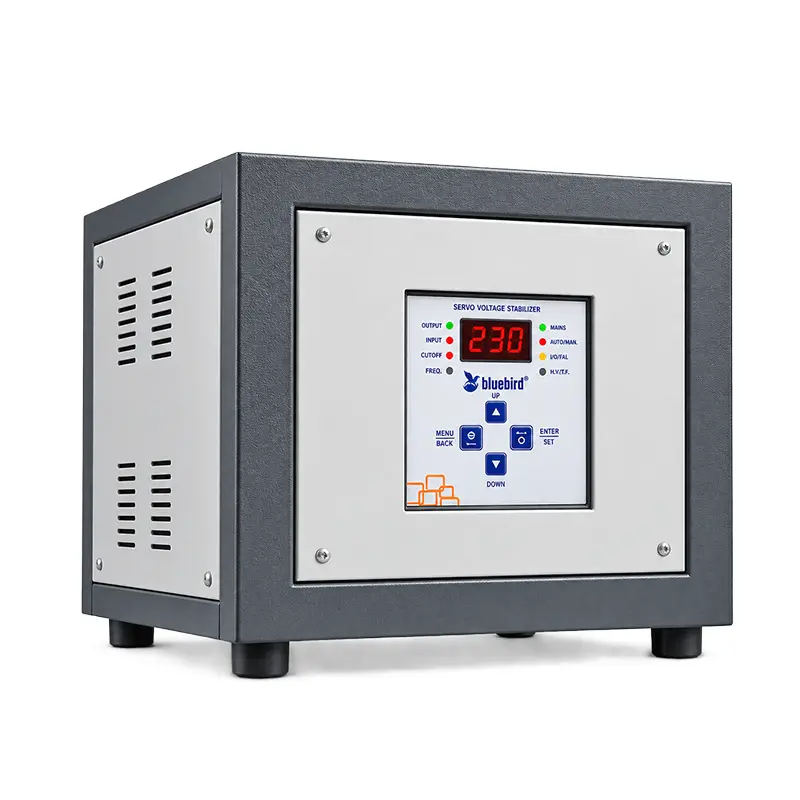
Automatic and servo voltage stabilizers both exist to correct the same underlying problem (mains voltage in India routinely drifts 15–20% away from its nameplate value), but they don’t correct it the same way, and the difference shows up the moment you look at what each one actually does under load. An automatic stabilizer (the relay-based kind covered in an earlier guide) switches between fixed transformer taps to land close to the target voltage. A servo stabilizer turns a motor-driven brush continuously along a transformer winding to land exactly on it. Picking between them is really a question of how much that gap between “close” and “exact” is worth to whatever’s plugged in.
Two Different Ways of Hitting the Same Target
A relay-type automatic stabilizer has a small number of fixed correction points built into its transformer (typically somewhere between 6 and 12 taps) and an electronic sensing circuit that picks the nearest one and switches a relay to connect it. There’s no continuous adjustment; the output jumps from tap to tap, which is why a relay unit’s accuracy tops out around ±8–10% of the target voltage even when it’s working correctly.
A servo stabilizer replaces those fixed taps with a carbon brush that a small motor drags continuously along a bare transformer winding, so instead of jumping between a handful of preset points, it can stop anywhere along that winding. That’s the mechanical reason a servo unit holds ±1%, roughly ten times tighter than a relay-type box, and also the reason it costs more: a servo motor, gearing, and a wound autotransformer are simply more to build and maintain than a bank of relays and fixed taps.
Speed Is Not the Same Question as Accuracy
It’s tempting to assume the more precise unit is also the faster one. It isn’t, and this is the detail that trips up a lot of buying decisions. A relay’s switching action is electronic: the sensing circuit detects an out-of-range voltage and fires the relay in a matter of milliseconds. A servo motor has to physically turn a shaft, and that motion is mechanically limited to roughly 15–20V of correction per second. Recovering from a swing of 180V to 220V takes a relay unit a near-instant switch; the same swing takes a servo unit about two seconds to walk through.
For the slow, gradual sag-and-recover pattern that most of the Indian grid produces, two seconds is fast enough that nothing downstream notices. But for a genuine transient (a spike from a nearby motor starting, a lightning-adjacent surge, a brief drop when a large load switches on elsewhere on the line), the relay’s electronic switching reacts before the servo motor has finished turning. This is the one area where the automatic stabilizer’s simpler mechanism is a real advantage rather than a compromise.
What You Pay, Upfront and Over Time
An automatic stabilizer is cheaper to buy and cheaper to run. It has no moving parts wearing against each other in normal operation (the relay contacts switch, but they’re not in continuous sliding contact the way a servo brush is), so maintenance is mostly limited to occasional servicing rather than a standing inspection schedule. Its lower per-unit cost is also why it’s the more common choice for smaller loads, where buying three or four small automatic units for separate circuits is still cheaper than one servo unit sized to cover all of them.
A servo stabilizer costs more on both counts. The carbon brush is in constant sliding contact with the transformer winding every time it corrects, so it wears, and a worn brush needs replacing before it starts arcing or leaving the output hunting around the target instead of settling on it. On a unit running continuously, that’s a once- or twice-yearly inspection at minimum. The motor also draws its own power to run, on top of whatever the stabilizer is correcting, which is part of why a servo unit’s running cost sits above a relay-type box doing a comparable job.
Matching the Stabilizer to the Load
The honest test isn’t which stabilizer is “better” in the abstract, it’s whether the equipment behind it can tell the difference between ±1% and ±8%. A refrigerator, a television, a fan, a set of tube lights: none of these have a control loop fine enough to register an 8% wobble as anything other than normal operation. That’s the entire market an automatic stabilizer is built for: homes, small shops, moderate-load commercial spaces, anywhere the connected load just needs protection from being fried by a genuine over-voltage or brownout rather than precision regulation.
Push into equipment with its own tight tolerances and the calculus flips. CNC spindles and injection-molding drives are tuned against an assumed supply voltage, and an 8–10% wander starts showing up as dimensional drift in the finished part. MRI gradient coils and X-ray generators need a supply that doesn’t sag mid-scan, because a sag shows up as an artifact in the image, not a warning light. Server racks and telecom base stations run banks of switch-mode power supplies whose lifespan shortens under unstable input. In every one of these cases the tighter regulation a servo stabilizer provides isn’t a nice-to-have, it’s the reason the equipment behind it keeps working at spec.
A Shortcut for Deciding
Two questions cover most of the decision. First: does anything downstream have its own tolerance narrower than about 5%? If everything connected is ordinary household or general commercial equipment, an automatic stabilizer covers it at a lower purchase and running cost, and its faster switching is actually an advantage against transient spikes. Second: is the load large, continuous, and precision-sensitive, like a factory floor, a diagnostic lab, a data center? That’s where the servo’s ±1% and its higher upkeep pay for themselves, because the cost of a stabilizer failing to hold voltage is higher than the cost of maintaining the stabilizer.
| Factor | Automatic (Relay-Type) | Servo |
|---|---|---|
| Voltage accuracy | ±8–10% | ±1% |
| Reaction to transient spikes | Faster (electronic switching) | Slower (mechanical, ~15–20V/sec) |
| Maintenance | Minimal, occasional servicing | Periodic brush inspection, oil checks on larger units |
| Purchase and running cost | Lower | Higher |
| Best suited to | Homes, small offices, general commercial loads | Industrial machinery, medical equipment, data centers |
Bluebird has built both automatic and servo voltage stabilizers out of Delhi for over four decades. If you’re not sure which one your load actually needs, that’s a sizing question worth getting answered before you order, not after installation.